
February 24, 2026 • 4 min read
Shift Left Was Meant to Help. Here's Why It's Burning Out Senior Engineers.
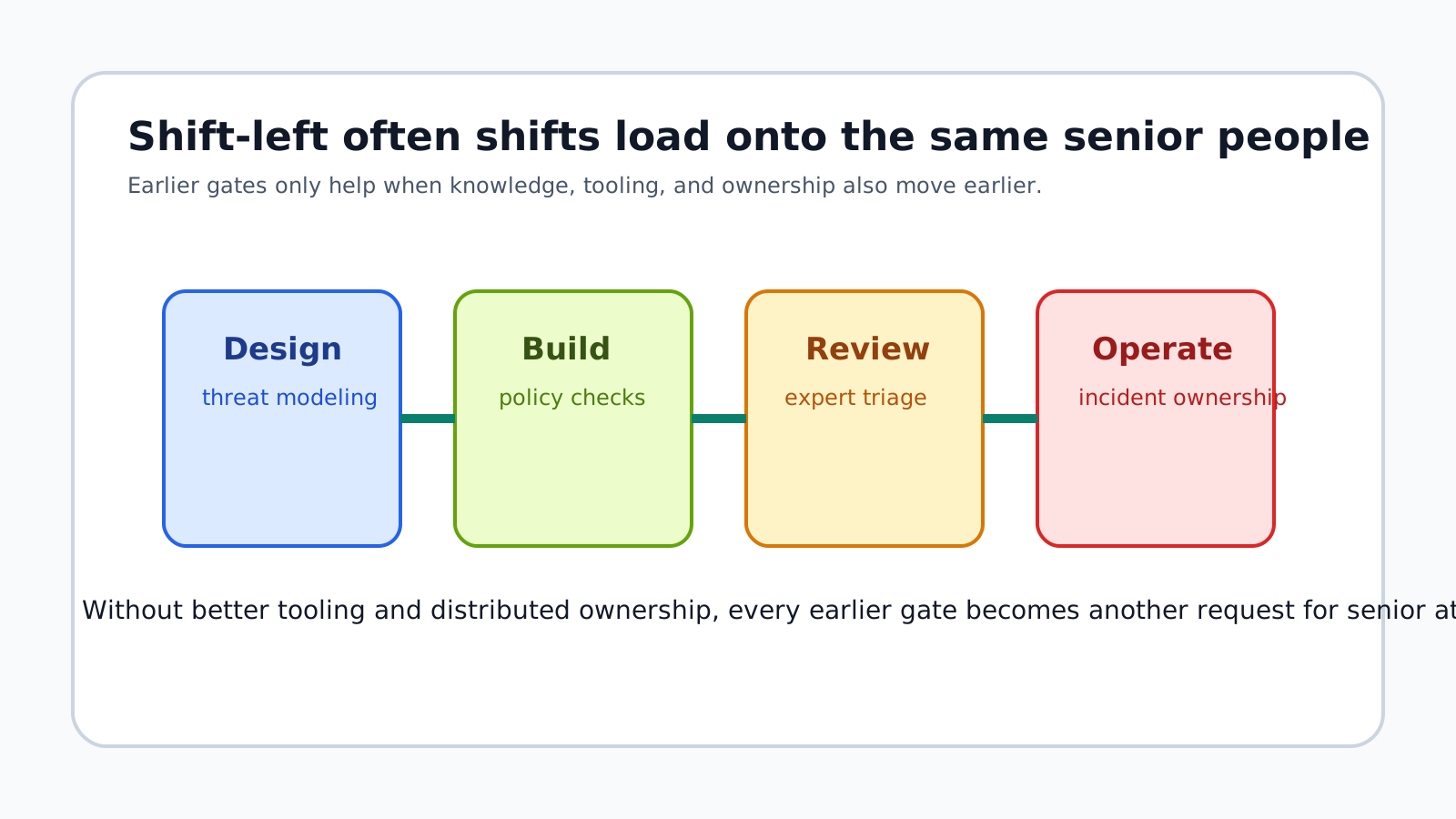
Shift-left programs can overload senior engineers when ownership, queue design, and exception handling are not explicitly rebalanced.
Last month I caught myself doing something I never expected.
I was on a Saturday morning coffee run, scrolling through pull requests on my phone, clearing security alerts so a release train would not miss its slot.
I was not reviewing logic. I was not thinking about customer impact. I was triaging tooling.
At some point, “shift left” stopped feeling like a quality practice and started feeling like a tax.
Not on teams in general. On senior engineers in particular.
The moment it became real
The week that pushed it over the line looked ordinary on paper.
- Monday: platform change merged.
- Tuesday: new dependency policy landed.
- Wednesday: CI failed because a FinOps check flagged an infrastructure change that added a few thousand dollars per month.
- Thursday: scanner rules updated and lit up half the repo with “critical” CVEs.
- Friday: rerun pipeline, suppress false positive, update lockfile, rerun, write exception ticket, repeat.
I looked at my calendar and realized I had spent more time reviewing alerts than reviewing code.
That is what “ownership” looks like when everything is shifted left, but nothing is shifted away.
What shift left was supposed to be
The original intent of shift left is solid.
Move feedback earlier. Catch issues when they are cheaper to fix. Make security and reliability part of development instead of a frantic audit at the end.
When done well, it reduces late surprises and improves lead time.
The issue is implementation. Most organizations treat shift left as an integration strategy, not a responsibility strategy.
- Add scanners to pull requests.
- Add policy gates to CI.
- Add FinOps checks to pipelines.
- Add blocking approvals.
What they often skip:
- Who owns each queue.
- Who defines and tunes the rules.
- How exceptions are handled and expired.
So the left side gets crowded, and the person standing closest to that crowd is usually the senior engineer.
How it shows up day to day
In practice, shift left often becomes “add another gate.”
Security adds SAST and dependency scanning. Platform adds policy-as-code. Finance adds cost estimation. Compliance adds audit evidence. Reliability adds SLO checks and chaos requirements.
Each control is defensible in isolation. Together, they create an attention economy inside the PR workflow.
Every alert asks to be urgent, but not every alert deserves attention. Most systems still do a poor job separating signal from noise, and teams are rarely incentivized to tune false positives aggressively.
Senior engineers become the human filter.
They know the service history, blast radius, and what can be deferred. They know which exception is safe and which is a future incident.
That judgment is valuable. Applying it fifty times a week is exhausting.
Why this hurts seniors more than anyone else
Junior engineers are overloaded by novelty. Senior engineers are overloaded by obligation.
A senior is expected to unblock pipelines, interpret scanner output, negotiate with security, and still deliver roadmap work. They also carry the implicit promise: “If things get weird, I will handle it.”
Shift left makes things weird more often.
The hard part is not effort. It is context switching across domains that are each deep enough to be a career.
You can be excellent at distributed systems and still weak at SCA triage. You can be strong in Kubernetes and still struggle with cost modeling at PR time. You can know your service cold and still lose hours to compliance evidence formatting.
None of that work is beneath a senior engineer. The problem is volume, fragmentation, and accountability without support.
When everything is every engineer’s job, it quietly becomes the senior engineer’s job.
Lessons learned
Early feedback is not the same as early responsibility. You can surface issues early without forcing every PR author to become a security analyst.
Every gate creates a queue. If you do not design that queue, it ends up in PR comments, DMs, and senior engineers’ heads.
Shift left without shift support is load shedding. If you want engineers to own more, give them clearer ownership boundaries, better tools, and dedicated time.
Quality systems must be trusted. Trust comes from precision, not volume. A small number of high-confidence blocks beats a flood of low-quality alerts.
Final takeaways
- Surface feedback early, but assign decisions clearly.
- Design the queue, or the queue designs itself.
- Block rarely, but with high confidence.
- Make exceptions visible, owned, and expiring.
- Treat pipeline friction as a first-class metric.