
February 25, 2026 • 4 min read
The Hidden Risk of Treating AI Prompts as Configuration
Prompt edits in production AI systems act like policy changes and require versioning, rollout controls, and safety testing.
The incident started like the worst kind: quiet.
Support pinged us with “the assistant is being weird again.” The on-call runbook had the usual suspects. Latency. Token limits. Model availability. A bad upstream dependency. Everything looked normal.
No deploys. No infrastructure drift. No feature flags flipped. And yet the system behaved differently. Nothing was deployed.
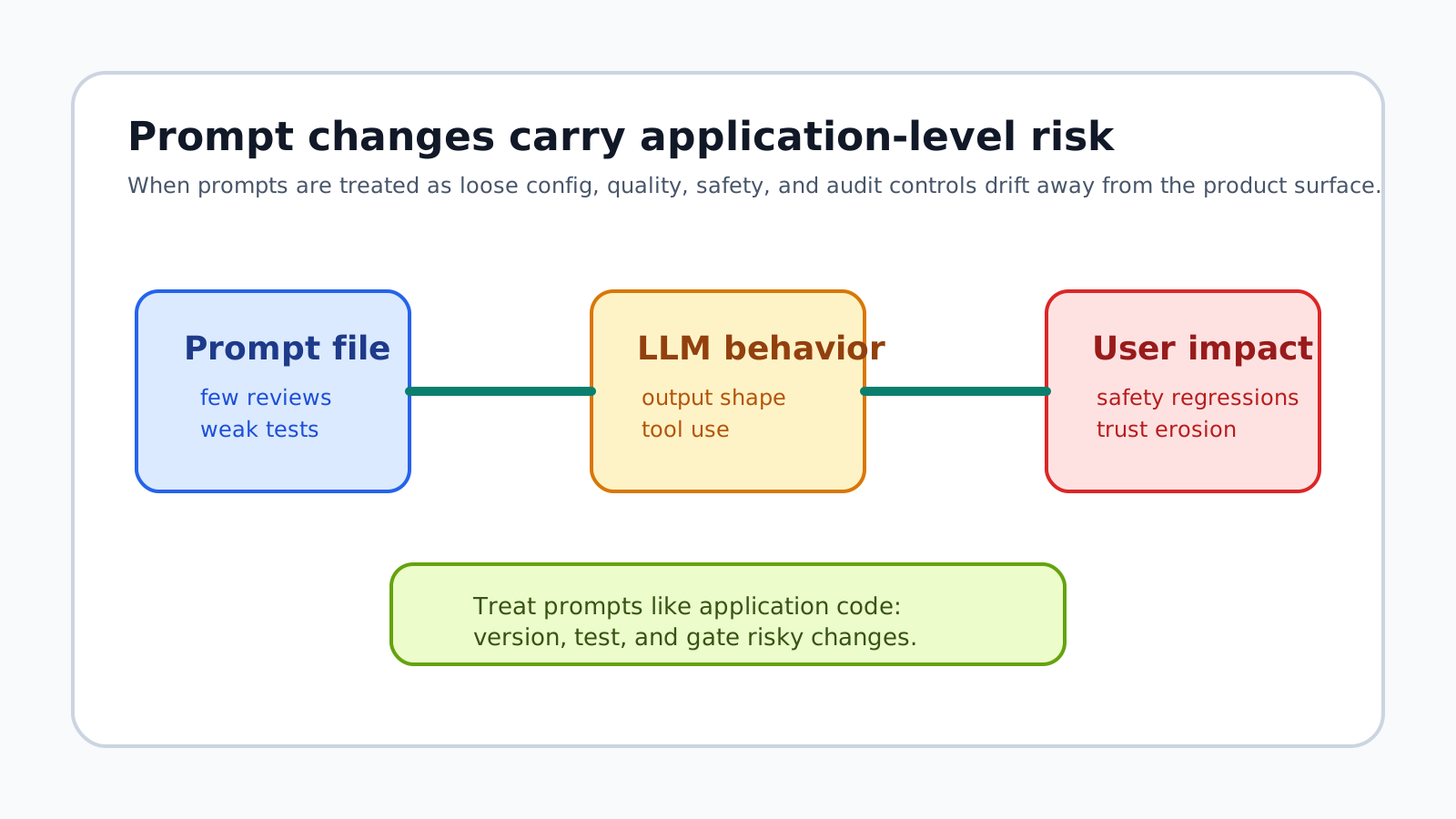
That’s when I learned a lesson I should have seen coming: in production, a prompt is not a string. It is executable policy.
The moment the problem became real
We had built an internal AI helper for our platform teams. It answered questions about service ownership, suggested rollback steps, and drafted incident updates. It was routed through an LLM gateway with guardrails and a retrieval step that pulled relevant docs from our knowledge base.
The prompt lived in a repo.
It felt responsible. Versioned. Reviewable. Reusable. Configurable.
A teammate tweaked a few lines to make the responses more decisive. It was a small change that looked harmless in a diff.
Then two things happened within the next day.
First, the assistant started recommending risky actions with too much confidence. It suggested deleting Kubernetes resources rather than scaling them down. Not always, not deterministically, but often enough to show a pattern.
Second, our incident channel got noisier. Engineers began asking whether the gateway changed or whether the model was updated. Nobody suspected the prompt, because the prompt was just configuration.
We were treating it like a theme file.
Why this problem matters
Platform engineering has a long history of learning this the hard way: configuration can be code when the configuration influences behavior. Kubernetes manifests decide scheduling and isolation. Ingress rules shape your attack surface. IAM policies control blast radius. The moment you can express intent or constraints, config becomes logic.
Prompts are joining that category.
A modern production prompt often does four things:
- Encodes business rules.
- Shapes decision boundaries.
- Determines data handling.
- Establishes tone that influences trust and behavior.
If your prompt decides whether an assistant suggests a rollback versus a wait, you have created a policy engine written in English instead of Python.
System context and constraints
The system included:
- A gateway service handling model routing and logging.
- A retrieval step pulling internal documentation.
- A prompt template with system and task sections.
- Multiple prompt variants for different workflows.
Constraints included compliance boundaries, safety controls, multi-team usage, and strict latency expectations.
Engineers felt more comfortable editing text than editing services. That is exactly why the risk hid in plain sight.
First attempts and dead ends
We compared model versions. No change.
We inspected retrieval. Stable.
We checked gateway logs. No anomalies.
We even ran a basic regression suite. It passed.
The assistant still felt different.
We were validating formatting, not decision safety.
The key insight
The breakthrough came from examining a risky recommendation screenshot. The assistant had suggested deleting a deployment outright.
A diff revealed a line encouraging the assistant to pick the most likely action when ambiguity appeared.
That line shifted policy from cautious to assertive.
We changed control logic without realizing it.
Treating prompts as code
We responded with structural changes.
Define invariants
We documented enforceable properties such as:
- Destructive actions must require confirmation.
- Uncertainty must be stated clearly.
- Secrets must never be exposed.
Version pinning
We created a prompt registry with immutable versions and pinned production to explicit IDs.
Canary rollout
We rolled prompts out gradually and measured safety-related signals before promotion.
Semantic test harness
We created scenario-driven tests that measured violation rates instead of expecting deterministic output.
Cross-functional review
Operational prompts required SRE review. Security-sensitive prompts required security review.
Prompts became governed artifacts.
Validation signals
We tracked:
- Prompt version usage.
- Safety violation rate.
- Escalation frequency.
- User feedback patterns.
The result was slightly more cautious responses and fewer risky recommendations.
That tradeoff was acceptable.
Tradeoffs considered
Locking prompts entirely would slow iteration.
Feature-flagging alone lacked auditability.
Dedicated prompt tooling may help later, but discipline mattered more than tooling.
We adopted versioning plus rollout discipline as the balanced approach.
Production hardening
We strengthened observability by logging prompt version and retrieval metadata.
We added prompt injection defenses.
We ensured fast rollback capability.
We treated prompt diffs as policy changes requiring clear explanation.
Lessons learned
A prompt is a policy document with side effects.
Small wording changes can alter system behavior dramatically.
Prompt rollout requires operational controls.
Semantic testing is necessary for safety boundaries.
Cross-functional review improves reliability.
Closing reflection
Calling prompts configuration makes them feel safe.
They are not.
If a prompt shapes decisions in production, it deserves the same rigor as code.
Where have you drawn your boundary between flexibility and control?
Final takeaways
- Prompts encode business logic in production systems.
- Treat prompt changes as behavioral changes.
- Use version pinning and controlled rollout.
- Test invariants, not just formatting.
- Review prompts like policy, not like copy.