
March 12, 2026 • 9 min read
Why GitOps Sync Loops Hide Latency Until Your Users Find It First
GitOps controllers prove configuration convergence, not service performance. Here is how sync loops can stay green while latency quietly gets worse.
Imagine a composite but very plausible Tuesday night for a platform engineer on release duty.
A payment service has a narrow maintenance window, and the only promise made to the product team was that the change would be boring. Argo CD synced the manifests in under a minute. The deployment looked clean. Five minutes later, support started reporting intermittent checkout timeouts from one region.
This is the kind of incident GitOps dashboards are bad at explaining. The sync loop did its job. The cluster converged on the desired state. Users still got a slower system.
That gap is the point of this post. GitOps controllers are excellent at reconciliation. They are not reliable judges of latency, user experience, or business readiness.
When the green dashboard stopped being reassuring
In the hypothetical release window above, the mistake was subtle. The service team added an auth sidecar and a few policy changes. Nothing crashed. Nothing failed admission. Kubernetes readiness passed because the process was alive and listening.
The hidden issue was response time. Every request now did a little more work before it reached the application. The added cost was not dramatic in isolation, but under real traffic it stacked up with an already warm database and a slightly slower upstream dependency.
Argo CD reported Synced and Healthy because those statuses answer a different question.
They answer whether the cluster matches declared configuration and whether the configured health checks say the workloads are up.
They do not answer whether the release preserved the user-facing latency budget.
That distinction sounds obvious when written down. In practice, many teams still treat the green box as a release verdict because it is the cleanest signal in the room.
Why this matters more as platforms standardize on GitOps
GitOps has encouraged a useful habit: separate intent from direct cluster mutation. That is good engineering. It improves auditability, rollback discipline, and drift control.
The trouble starts when teams stretch the model too far. Configuration convergence is treated as operational success. Controller health is treated as service health. A quick sync is treated as fast delivery.
That mental shortcut is attractive because it compresses a messy system into one green indicator. It is also how latency regressions get normalized.
Latency is especially easy to miss because it often arrives as a slope, not a cliff. Error rates may stay low. Pods may stay ready. CPU may look acceptable. Only the user journey gets worse first.
If your deployment decision ends at reconciliation, the first serious detector may be a customer, a support queue, or an SLO burn alert that fires after the release has already settled in.
The constraints that make this problem real
The pattern is most dangerous in environments that look ordinary.
Assume a central GitOps controller, a few dozen services, progressive delivery that is still more aspirational than real, and teams that rely on Kubernetes readiness plus controller health to tell them a rollout is done. Assume the platform team values standardization, so every service inherits the same deployment path whether it is latency-sensitive or not. Assume engineers are under pressure to keep change windows short, which means the shortest success signal tends to win.
None of that is reckless. It is a normal platform. That is exactly why this failure mode matters.
The dead ends we tried first
The first instinct is usually to make the sync loop faster or stricter. We tried both in versions of this problem, and neither fixed the thing we actually cared about.
Shorter reconcile intervals made drift correction faster, but they did nothing for the release itself. If a new configuration introduced 180 milliseconds of extra request time, discovering that every 30 seconds instead of every 3 minutes was not the breakthrough it sounded like in planning meetings.
We also tried to stuff more logic into readiness probes. That helped catch some obvious failures, but readiness probes are the wrong place for real latency validation. Once the probe started simulating real downstream dependencies, it became noisy, slow, and vulnerable to warm-up effects. At that point, we had not built a better release gate. We had just built a fragile miniature load test into pod startup.
Another dead end was relying on the GitOps health model alone and telling ourselves that application telemetry would catch anything important later. That is operationally equivalent to saying the release can finish before validation starts. If you work on low-risk internal tooling, maybe that is acceptable. For user-facing systems, it is usually where trouble hides.
The turning point
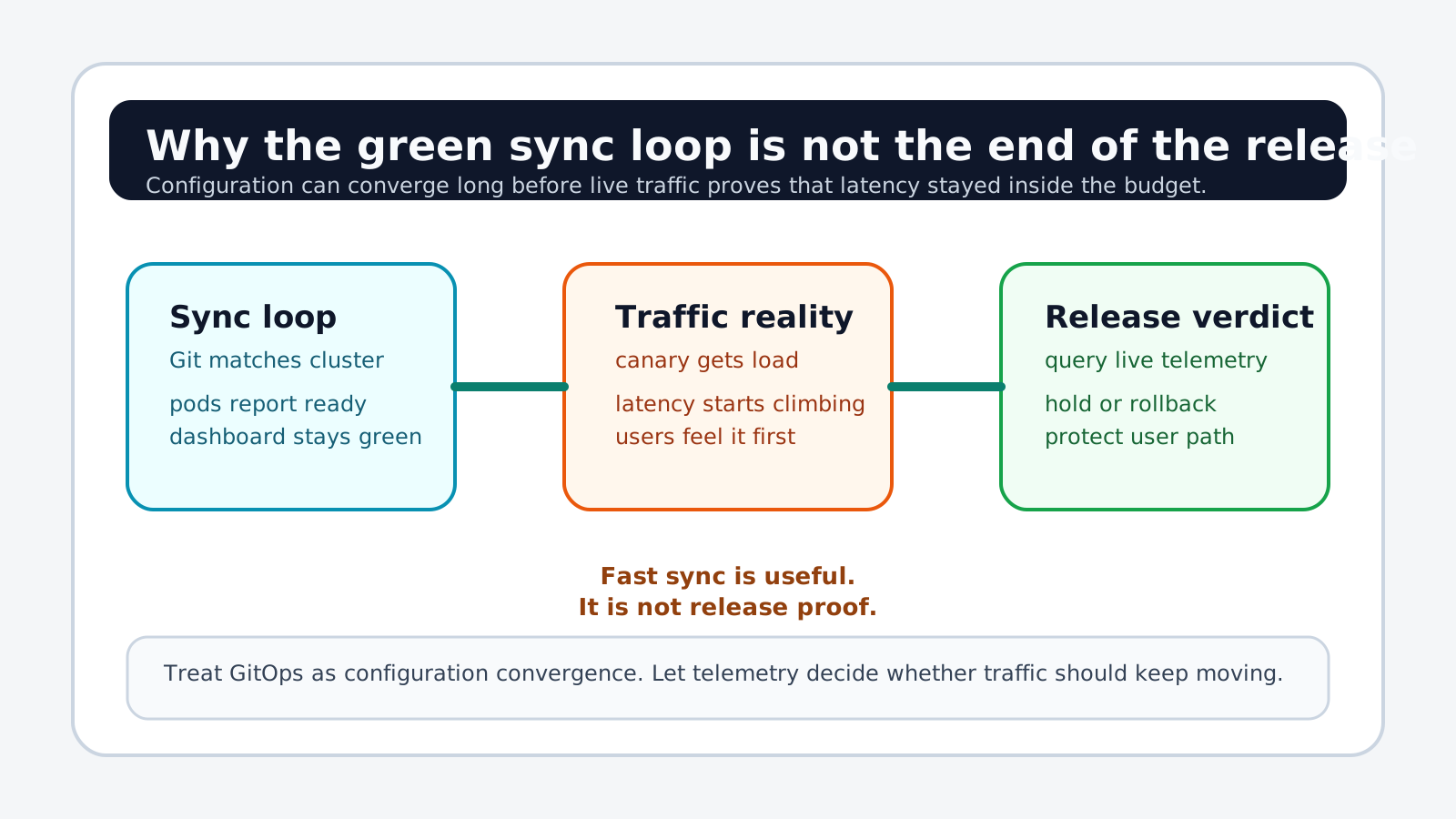
The useful mental shift was simple: GitOps is a configuration control loop, not a latency control loop.
Once we said that out loud, the architecture got clearer. The sync loop should prove that the cluster moved to the intended state. A separate verification path should decide whether that intended state deserves to keep serving traffic.
Those are related concerns, but they are not the same concern.
In that hypothetical incident, the turning point would have been a graph, not a dashboard badge. P95 and P99 latency would climb immediately after traffic reached the new pods, while the GitOps status remained fully green. That is the signal that tells you the release is operationally wrong even though it is declaratively correct.
The platform lesson is that reconciliation success needs a second-stage verdict from telemetry. Without that second stage, the sync loop becomes a false finish line.
A safer release pattern
The practical fix is not to abandon GitOps. It is to stop asking GitOps to answer questions it cannot answer.
We had the best results with a two-layer model. GitOps applies and reconciles the desired state. A release-verification step then checks live signals before the rollout is considered complete.
That verification layer can be implemented a few ways. Some teams use Argo Rollouts analysis templates. Some rely on service mesh metrics, synthetic checks, or direct SLO queries in Prometheus. The mechanism matters less than the decision boundary: a deployment is not successful because manifests synced, but because latency, errors, and availability stayed within guardrails after traffic moved.
A stripped-down example with Argo Rollouts and a Prometheus latency gate looks like this:
apiVersion: argoproj.io/v1alpha1
kind: AnalysisTemplate
metadata:
  name: checkout-latency
spec:
  metrics:
    - name: p95-latency
      interval: 1m
      successCondition: result[0] < 0.35
      failureLimit: 2
      provider:
        prometheus:
          address: http://prometheus.monitoring.svc.cluster.local:9090
          query: |
            histogram_quantile(
              0.95,
              sum by (le) (
                rate(http_request_duration_seconds_bucket{service="checkout"}[5m])
              )
            )
---
apiVersion: argoproj.io/v1alpha1
kind: Rollout
metadata:
  name: checkout
spec:
  replicas: 6
  strategy:
    canary:
      steps:
        - setWeight: 20
        - pause:
            duration: 5m
        - analysis:
            templates:
              - templateName: checkout-latency
  selector:
    matchLabels:
      app: checkout
  template:
    metadata:
      labels:
        app: checkout
    spec:
      containers:
        - name: app
          image: ghcr.io/example/checkout:2.4.1
GitOps still manages this rollout object. The important change is that traffic progression now depends on telemetry, not just on reconciliation.
What to measure if latency is the risk
This is where teams often stay too generic. If you want to catch hidden latency, you need signals that are closer to user impact than to infrastructure liveness.
The best release gates usually include request latency percentiles, request success rate, saturation on the immediate downstream dependency, and at least one synthetic or business-path check that proves the critical flow still works.
For a checkout service, that may be add-to-cart, token exchange, and payment authorization rather than a generic /healthz endpoint.
The other critical metric is time-to-detect after traffic shift. If your telemetry takes ten minutes to tell you the canary got slower, your rollback path is already too late for fast-moving releases.
Operational concerns that show up immediately
A telemetry gate buys real protection, but it is not free.
Rollback gets more disciplined because the previous Git revision is still the cleanest source of truth, but now the revert needs to align with rollout controller state and any in-flight analysis runs. That means your platform should have one obvious rollback path instead of a mixture of Git revert, manual scale changes, and dashboard clicks.
Testing also has to move closer to production behavior. A staging environment with no meaningful load will not tell you much about a latency regression caused by sidecars, DNS policy, mTLS settings, or a new network hop. You need rehearsal conditions that at least resemble the dependency profile of production, even if the traffic volume is lower.
Security and DX come along for the ride. Security teams tend to like GitOps because every intent is reviewed in Git, but they also need to be comfortable with automated rollback actions that mutate desired state quickly. Developers need templates that make the right release checks easy to adopt, or they will fall back to whatever passes fastest.
Hard edges and trade-offs
There are real trade-offs here.
If every deployment waits on ten minutes of metrics, your release cycle slows down. If your SLO queries are noisy, engineers will lose trust and bypass the gate. If your rollback automation is too eager, you can oscillate on transient noise and create a second outage out of a mild regression.
That is why the goal is not maximal verification. It is decision-quality verification.
For low-risk services, sync plus basic health may be enough. For customer-facing paths with tight latency budgets, it usually is not. The platform should let those two service classes behave differently without making the safer path feel custom-built every time.
Lessons that lasted
The lesson that stuck for me is that green control planes are often telling the truth, just not the truth you need.
Argo CD can honestly tell you the cluster matches Git while your release is making users wait longer. Neither signal is wrong. They are about different layers of the system.
Once you accept that, the architecture becomes less ideological. GitOps remains the source of declarative intent. Observability becomes the source of release truth. Progressive delivery becomes the bridge between the two.
Closing reflection
The real trap is not GitOps itself. It is the temptation to collapse configuration, rollout, and user experience into one status field because one status field feels operationally neat.
In the composite story above, the bad night did not come from missing YAML or a broken controller. It came from trusting the fastest available success signal instead of the most relevant one.
That is the discussion worth having on platform teams. When your sync loop goes green, what exactly has been proven, and what still needs to be earned from live telemetry before you call the release safe?
Final takeaways
- A GitOps sync loop proves convergence, not that your latency budget survived the release.
- Readiness probes and controller health are useful, but they are weak proxies for user-facing performance.
- Treat telemetry as a release gate after reconciliation, especially for services that sit on critical user paths.
- The right target is not more sync speed. It is a clearer separation between desired state, traffic shift, and rollback decisions.