
February 27, 2026 • 6 min read
We Automated the Incident, and Lost the Learning
Fast auto-remediation can hide root causes. This post outlines how to keep incident automation without losing organizational learning.
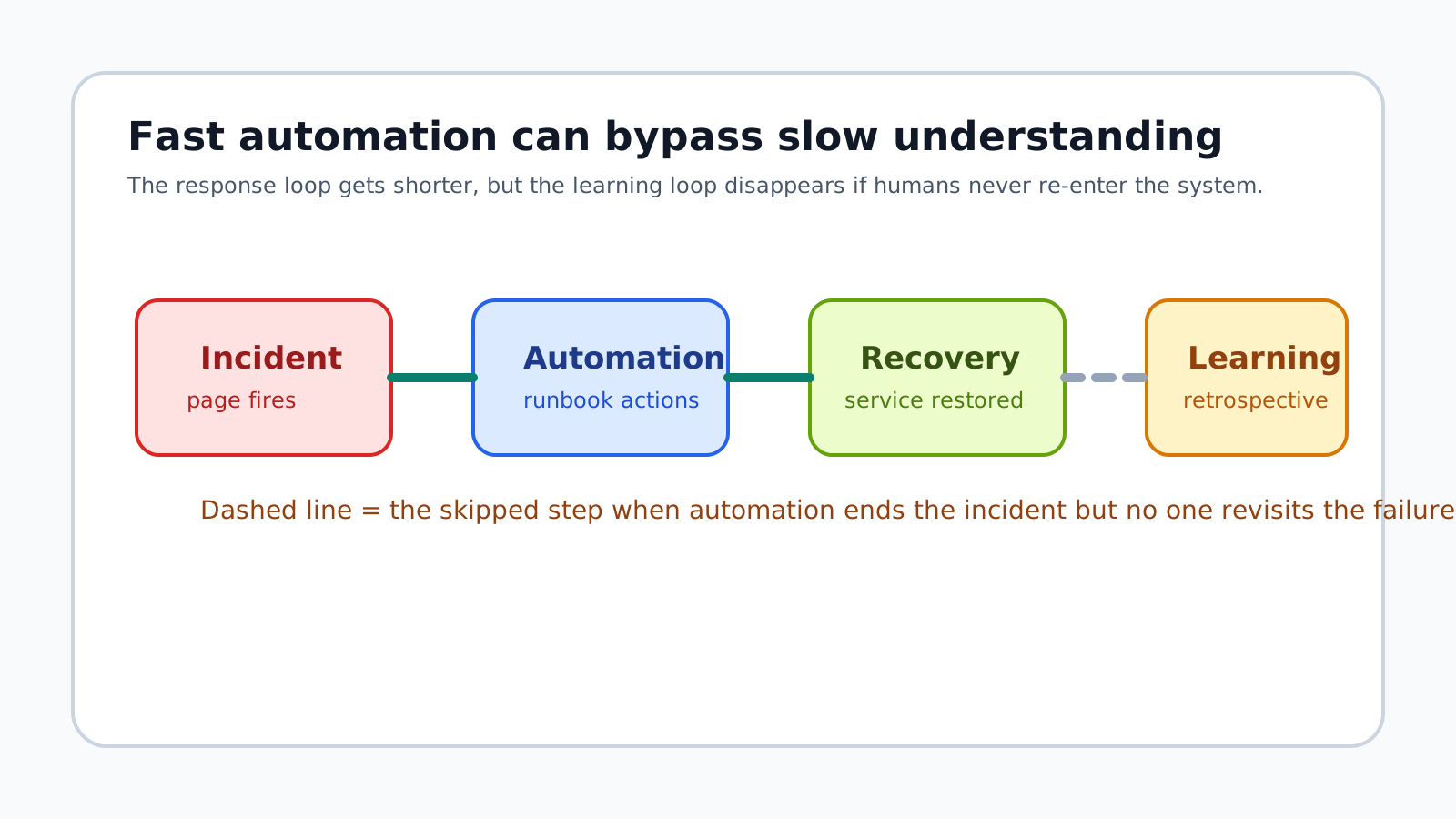
The alert fired at 02:13. By 02:14, the service was green again.
By 09:30, in the daylight, we realized something worse than an outage had happened. We had no idea why it recovered. No one could explain what broke, what healed it, or whether we were now one bad deploy away from the same failure returning with a different shape.
The incident resolved itself. That was the problem.
I’m not anti automation. I’ve spent years building runbooks that run themselves, autoscalers that prevent pager noise, and remediation workflows that turn the most common failures into non events. I still think those are good goals.
But somewhere along the way, we built an incident response system that optimized for “time to green” so hard it stopped producing understanding. We didn’t just reduce pain. We reduced learning.
This is a story about how that happened, what it cost, and what we changed so our platform could still heal itself without turning the team into passengers.
Why this matters more than it sounds
A fast recovery time looks great on a dashboard. It’s measurable, easy to celebrate, and it maps cleanly to SLOs.
Understanding does not.
Understanding is messy. It shows up as fewer repeat incidents three months later. It shows up when a new engineer can reason about failure modes without reading a 40 page postmortem. It shows up when you can confidently say “this will not happen again,” and mean it.
When you remove the learning loop from incidents, you get a quiet, brittle system. It behaves until it doesn’t, and when it doesn’t, you have fewer humans who can debug it under pressure because the system has been quietly doing all the debugging for them.
We started to see the symptoms:
- Postmortems got shorter and vaguer even when incidents were frequent.
- Mitigations became “add another auto remediation” instead of fixing root causes.
- On call engineers became operators of a tool, not owners of a system.
It’s easy to mistake those for team culture issues. In our case, it was architecture.
The system context and constraints
We were running a set of Kubernetes based services behind an API gateway, with a mix of stateless workloads and a couple of stateful dependencies such as a managed database and a cache cluster.
We had the usual pressures: a real uptime target tied to customer contracts, a small platform team supporting many product teams, security and compliance requirements that discouraged ad hoc access in production, and a desire to reduce pager fatigue because burnout was already visible.
We also had an automated remediation pipeline that felt like a breakthrough at first.
Alerts flowed into an event router. The router matched patterns, enriched context, and triggered remediation actions such as restarting pods, draining nodes, rolling back canaries, or scaling deployments. All actions were logged for audit purposes.
Later, we added a scoring layer that chose from multiple actions and escalated if confidence was low. Eventually we experimented with an AI assistant that summarized similar past incidents and suggested next steps.
None of this was unreasonable.
The failure was in what we stopped doing.
First attempts and dead ends
When we noticed the learning gap, we first tried to fix it with process. We improved incident templates. We required summaries. We added root cause fields.
It did not help.
Postmortems became more polished without becoming more accurate. People filled in fields with the best story they could assemble from incomplete data.
Then we tried reducing automation and adding manual approval before remediation.
That made things worse. It increased toil but still did not restore understanding, because the core problem was timing.
The system recovered before humans could observe the failure state meaningfully. Logs rotated. Pods restarted. Traces disappeared. The remediation pipeline had effectively cleaned the crime scene.
The automation did not just resolve the incident. It erased it.
The turning point
A new engineer asked, “What’s our top recurring incident pattern?”
We answered: “Cache saturation.”
Then came the follow up: “Do we know what causes it?”
We did not.
The alert would trigger, the system would scale the cache tier, latency would drop, and we would move on. The postmortem would say “cache scaled.” The cycle repeated.
We were treating the alert as the cause.
We reviewed the last twenty incidents and tried to reconstruct a causal chain. We could not. We had remediation actions and recovery confirmation, but little about system state before remediation.
We needed automation that preserved evidence and forced learning.
What we changed
We redesigned the pipeline around a simple principle: If the system self heals, it must also self explain.
That led to three changes.
First, we capture a forensic bundle before remediation.
Second, we treat remediation actions as structured, observable events.
Third, we introduce a lightweight learning loop based on recurrence and severity.
Forensic bundles before remediation
We added a pre action capture stage that stores structured evidence: metrics snapshots, targeted logs, Kubernetes events, and trace samples.
A simplified version looked like this:
def capture_forensic_bundle(event, capture_client, store):
    payload = {
        "incident_id": event["id"],
        "service": event["service"],
        "metrics": capture_client.snapshot_metrics(event["service"]),
        "logs": capture_client.tail_logs(event["service"], lines=500),
        "events": capture_client.k8s_events(event["namespace"]),
    }
    store.put(f'incidents/{event["id"]}.json', payload)
Bundles are created before remediation runs. They are structured so patterns can be compared across incidents.
Remediation as first class events
We now record what action ran, why it was chosen, and what signal changed afterward. This lets us evaluate whether scaling, restarting, or failing over truly addressed the underlying issue or merely suppressed symptoms.
Lightweight learning loops
We avoid heavy postmortems for minor incidents. Instead:
- Rare, low impact incidents generate an auto summary with bundle links.
- Repeated incidents open a learning ticket linking recent bundles.
- High severity incidents require formal review even if auto resolved.
This respects human time while preserving institutional learning.
Validation
We tracked bundle coverage, recurrence rates, and the quality of causal hypotheses during reviews.
The most important shift was cultural. Engineers stopped saying “it fixed itself.” They started saying “it restarted after a memory spike; the bundle shows allocator pressure. Let’s examine the last release.”
That is not perfect knowledge, but it is progress.
Tradeoffs
Full automation without learning risks long term fragility. Fully manual response preserves learning but does not scale. The hybrid approach adds complexity but balances uptime with understanding.
It requires disciplined bundle specs, safe storage, and guardrails against runaway auto scaling.
Production hardening
Bundles must be size limited, encrypted, and access controlled.
Capture failure must not silently proceed in high severity incidents.
Automation must include guardrails to prevent masking regressions with endless scaling.
Lessons learned
- Recovery without evidence is deferred risk.
- Automation that mutates production must generate explanation artifacts.
- Incident response is a learning system.
- Humans should be optional in execution, not optional in understanding.
- Reliability improves when learning loops are preserved.
Closing reflection
Self healing systems are valuable. But if they remove the information needed to understand failure, they quietly weaken the team.
The goal is not slower recovery. The goal is recovery that leaves behind insight.
If your system heals at 02:14, ask yourself what you know at 09:30.